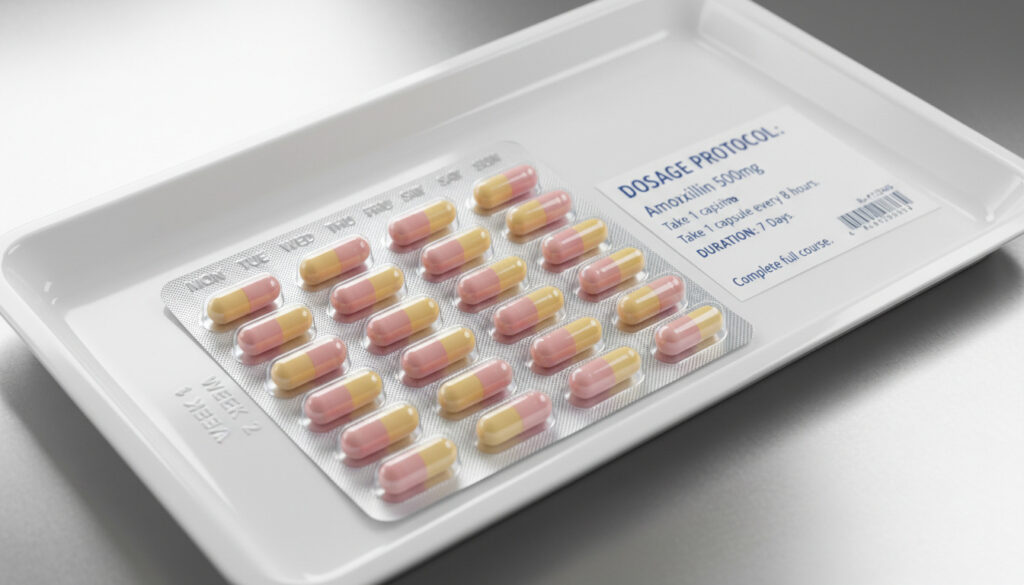
Amoxicillin 500mg Dosage for Adults – Frequency, Duration and Guidelines
Amoxicillin 500mg represents one of the most frequently prescribed antibiotic strengths for adult bacterial infections. Standard regimens typically involve 500 milligrams taken every eight hours, though specific protocols adjust based on infection severity and patient physiology.
Medical authorities including the NHS, Mayo Clinic, and British National Formulary maintain consistent baseline recommendations, with variations emerging for severe presentations, renal impairment, or specific pathogens like H. pylori. Understanding these parameters supports effective bacterial eradication while minimizing antimicrobial resistance risks.
This examination presents evidence-based dosing schedules, duration protocols, and safety considerations derived from current clinical guidelines.
What is the standard Amoxicillin 500mg dosage for adults?
500mg every 8 hours for mild to moderate infections
Three times daily, evenly spaced
7 to 10 days for standard courses
Bacterial respiratory, skin, and urinary infections
Clinical guidelines establish several critical dosing principles:
- Severe infections may require 875mg every 12 hours or 1g doses for specific conditions
- Maximum daily intake typically caps at 3 grams for adults under normal renal function
- Patients with creatinine clearance below 30 mL/min require extended 12-24 hour intervals
- Completing the full prescribed course prevents bacterial resistance development
- Administration with food reduces gastrointestinal discomfort
- Capsules should be swallowed whole with water rather than chewed
| Scenario | Dose | Frequency | Duration |
|---|---|---|---|
| Mild-moderate ear/nose/throat | 500mg | Every 8 hours | 7-10 days |
| Severe lower respiratory | 500-875mg | Every 8-12 hours | 7-10 days |
| H. pylori eradication | 1,000mg (2 capsules) | Every 12 hours | 14 days |
| Lyme disease | 500mg | Every 8 hours | 14 days |
| Uncomplicated UTI (single dose) | 3,000mg (6 capsules) | Once | Initial treatment only |
| Renal impairment (CrCl <30) | 250-500mg | Every 12-24 hours | Per condition |
Sources: NHS, Mayo Clinic
How many times a day do you take Amoxicillin 500mg?
Standard protocols require three daily administrations for the 500mg strength. NHS guidance specifies spacing doses evenly, such as 8am, 4pm, and midnight, to maintain consistent blood concentration levels.
Twice-daily alternatives for severe infections
Severe infections may utilize 875mg every 12 hours instead of 500mg every eight hours, effectively reducing frequency while maintaining therapeutic levels. This approach applies specifically to lower respiratory tract infections or severe skin presentations under medical supervision.
Renal adjustment schedules
MedCentral data indicates patients with compromised kidney function require extended intervals. Creatinine clearance below 30 mL/min necessitates reduction to 250-500mg every 12-24 hours to prevent accumulation and toxicity.
Swallow capsules whole with water. Taking doses at the same times daily improves adherence. If stomach upset occurs, administration with meals remains acceptable though absorption rates stay consistent regardless of food intake.
How many days should you take Amoxicillin 500mg?
Treatment duration varies by infection type and severity. Standard courses range between 7-10 days for common bacterial infections, while specific conditions require extended protocols.
Standard 7-10 day courses
Ear, nose, throat, and uncomplicated skin infections typically resolve within 7-10 days. GoodRx estimates indicate 20-30 capsules cover standard 10-day courses at three times daily dosing.
Extended 14-day protocols
H. pylori eradication and Lyme disease treatment specifically require 14 days regardless of symptom improvement. These conditions involve persistent pathogens necessitating longer exposure to antimicrobial agents.
Completing the full course
Medical authorities emphasize continuing medication even after symptom resolution. Clinical guidelines confirm premature discontinuation risks bacterial resistance and incomplete infection clearance.
What is Amoxicillin 500mg used for?
Amoxicillin 500mg targets susceptible bacterial infections across multiple body systems. MedlinePlus confirms efficacy against pneumonia, bronchitis, and urinary tract infections, while excluding viral conditions like colds or influenza.
Respiratory and ENT applications
The antibiotic serves as first-line treatment for community-acquired pneumonia, acute bacterial sinusitis, and streptococcal pharyngitis. Lower respiratory infections often require the higher 875mg every-12-hour dosing schedule.
Gastrointestinal and systemic infections
Helicobacter pylori eradication represents a specific use case requiring combination therapy with clarithromycin and proton pump inhibitors. Lyme disease protocols also utilize the 500mg strength for 14-day courses targeting erythema migrans and related manifestations.
Amoxicillin provides no efficacy against viral pathogens. Prescription requires confirmed or strongly suspected bacterial infection. Body Mass Index Calculator – Accurate NHS Charts and Guide offers general health assessment tools separate from infection diagnosis.
H. pylori treatment mandates concurrent administration with lansoprazole and clarithromycin for 14 days. Dual therapy alternatives using only lansoprazole require 1,000mg every eight hours rather than the standard 500mg regimen.
What happens during a typical treatment course?
- : Symptom improvement typically begins as bacterial loads decrease, though full eradication requires continuation.
- : Standard course completion for ear, nose, throat, and uncomplicated skin infections.
- : Completion target for lower respiratory infections and severe presentations.
- : Full course completion for H. pylori eradication and Lyme disease protocols.
Is 500mg of Amoxicillin a high dose for adults?
Established Parameters
- 500mg constitutes standard adult dosing, not elevated dosing
- Severe infections escalate to 875mg or 1,000mg per administration
- Maximum safe daily intake reaches 3 grams in divided doses
- Toxicity thresholds remain significantly higher than therapeutic doses
Variable Considerations
- Specific duration without medical consultation varies by individual
- Self-adjustment protocols for missed doses remain undefined
- Weight-based modifications for adults outside standard BMI ranges
When and why Amoxicillin 500mg is prescribed
Penicillin-class antibiotics remain foundational to bacterial infection management due to broad-spectrum efficacy and established safety profiles. Amoxicillin specifically offers improved gastric acid stability compared to earlier penicillin derivatives, enhancing oral absorption rates.
Prescription decisions weigh infection severity, local resistance patterns, and patient allergy histories against potential benefits. BNF guidelines align with NHS and Mayo Clinic standards, positioning 500mg as the baseline adult strength with escalation pathways for complicated presentations.
Recovery support for mobility-related conditions may involve additional therapeutic interventions. Physical Therapy Near Me – NHS Self-Referral and Private Guide provides resources for post-infection rehabilitation.
What medical authorities say about dosing protocols
250 to 500 mg every 8 hours or 500 to 875 mg every 12 hours for general infections.
Mayo Clinic
500 mg capsules three times daily, swallowed whole with water.
NHS UK
Additional guidance from NCBI emphasizes renal adjustment necessities and allergy contraindications across all dosing schedules.
Essential guidelines for safe administration
Standard Amoxicillin 500mg therapy requires 500mg administration every eight hours for seven to ten days, with severe infections or H. pylori necessitating alternate schedules up to 14 days. Renal function, infection severity, and penicillin allergy status determine individualized protocols. Patients must maintain consistent dosing intervals, avoid premature discontinuation regardless of symptom resolution, and verify compatibility with existing conditions through medical consultation. Physical Therapy Near Me – NHS Self-Referral and Private Guide may support recovery planning for mobility-affected patients.
Frequently asked questions
How much does Amoxicillin 500mg cost?
Generic Amoxicillin 500mg typically costs between $4 and $20 for a 10-day course according to GoodRx estimates. NHS prescriptions in the UK are provided at standard prescription charges or free depending on eligibility.
What are the common side effects?
Nausea, vomiting, diarrhea, and skin rash occur frequently. These effects usually resolve after completing the course. Severe reactions require immediate medical attention.
Can I drink alcohol while taking Amoxicillin?
No direct pharmacokinetic interaction exists, though alcohol may exacerbate gastrointestinal side effects and impair immune response. Medical guidance suggests avoiding alcohol during the treatment period.
Should I stop taking Amoxicillin if I feel better?
Never discontinue early. Completing the full prescribed course prevents antibiotic resistance and ensures complete bacterial eradication, even if symptoms resolve before the course ends.
What if I miss a dose?
Take the missed dose when remembered unless it is nearly time for the next scheduled dose. Never double up doses to compensate for the missed administration.
Is 500mg safe for all adults?
Standard for most adults, but contraindicated in penicillin allergy. Patients with kidney disease require adjusted intervals. Pregnant or breastfeeding women should consult physicians before use.
More related posts
 Symptoms of Stomach Cancer: Early Signs and When to See a Doctor
 Guardians of the Galaxy 3 – Release Date, Cast and Soundtrack Guide
 Country to Country 2026: Dates, Lineup, Tickets, Venues
 India vs West Indies T20 2026: Scorecard and Highlights
 Edexcel Grade Boundarie 2025: GCSE, A Level, IGCSE Guide
 Motorola Razr 40 Ultra Review: Specs, Price & Comparison
 Best Advent Calendars 2025 – Top UK Adult Picks Reviewed