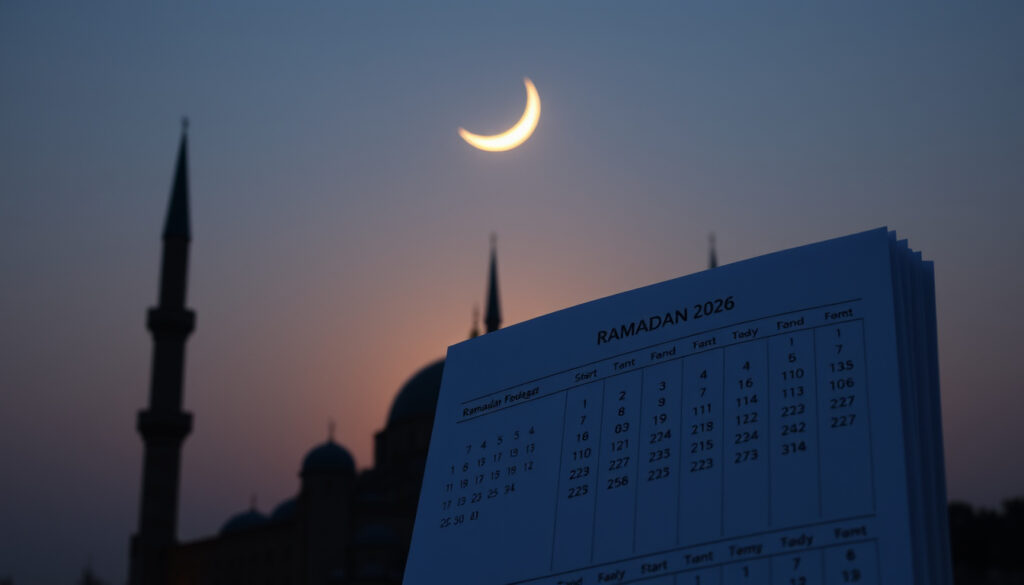
When Is Ramadan 2026? Start, End Dates & Fasting Times
Ramadan falls in February 2026 instead of its usual spring slot because the Islamic lunar calendar creeps roughly 10–11 days earlier through the Gregorian year each cycle. That timing shift means shorter fasting windows, earlier sahur alarms, and a moon-sighting drama that plays out differently across regions. By the end of this piece, you will have the predicted dates, regional variations, and the specific rules that actually govern the holy month.
Expected Start: Evening of February 17, 2026 · Expected End: Evening of March 18, 2026 · Hijri Year: 1447 AH · First Fast: February 18, 2026 · Eid al-Fitr: March 20, 2026
Quick snapshot
- First day of Ramadan is Wednesday, February 18, 2026, per Fiqh Council (Fiqh Council)
- Astronomical new moon born February 17, 2026 at 7:01 AM EST (Central Hilal Committee)
- Moon NOT sighted in North America on February 17 evening (Central Hilal Committee)
- Which specific North American communities observe February 19 instead of February 18
- India’s exact sighting date remains pending confirmation
- Saudi Arabia/Gulf moon-sighting result on February 17 evening
- New moon Shawwal born evening March 19, 2026 (Fiqh Council)
- Eid al-Fitr predicted Friday, March 20, 2026 (Moonsighting.com)
- DST shift March 1 affects late-Ramadan US fasting hours (Fiqh Council)
- Regional announcements expected February 17–18 evening
- Confirm your local mosque or hilal committee for final dates
- Eid al-Fitr preparations begin around March 18–19
Six data points govern the 2026 Ramadan picture — here is how they map across the calendar.
| Label | Value |
|---|---|
| Hijri Year | 1447 AH |
| Astronomical New Moon | February 17, 2026 (7:01 AM EST) |
| Predicted Start | February 18, 2026 |
| Predicted End | March 19, 2026 |
| Moon Sighting | Determines exact dates regionally |
| Eid al-Fitr | March 20, 2026 (predicted) |
| North America First Day | February 19, 2026 (likely) |
When is Ramadan 2026?
The Fiqh Council of North America predicts the first day of fasting as Wednesday, February 18, 2026, with the holy month beginning the evening of February 17 (Fiqh Council). However, the Central Hilal Committee reported that the moon was NOT sighted in North America on the evening of February 17, 2026 (Central Hilal Committee). That non-sighting pushes the practical start date for many North American communities to February 19, 2026 — a full day later than the astronomical prediction. The astronomical new moon for Ramadan 1447 AH was born on February 17, 2026 at 7:01 AM EST, according to the Central Hilal Committee.
Start date
Most predictions align on February 18 as the theoretical first day of fasting — that is when the Fiqh Council, Muslim Hands USA, and Islamic Relief all expect Ramadan to begin (Muslim Hands USA). But the actual start depends on whether the hilal (crescent moon) was visibly sighted on February 17 evening in each region.
End date
The new moon of Shawwal 1447 AH is predicted to be born on the evening of March 19, 2026, which places Eid al-Fitr on Friday, March 20, 2026, per both the Fiqh Council and Moonsighting.com (Moonsighting.com).
Fasting times
Sample prayer times for Boston on February 18, 2026: Fajr begins at 05:02 EST and Maghrib (iftar) at 17:20 EST, with Isha at 18:49 EST (Aladhan). For Houston, the Islamic Society Greater Houston lists Imsak at 5:52 AM on the first day (Islamic Society Greater Houston). One wrinkle: daylight saving time kicks in March 1, which compresses morning fasting windows in the final ten days of Ramadan for US observers.
In Pakistan
Pakistan typically follows the ruet-e-hilal sighting method and coordinates with Saudi Arabia. Regional analysts expect Gulf and Saudi communities to potentially sight the moon on February 17 evening, which would put Pakistan’s first fasting day on February 18 alongside Saudi Arabia (Times of India).
In India
India’s sighting tends to align with its own local observation. The Times of India reports that India is likely to sight the moon on February 18, with fasting potentially starting February 19 or even February 20 in some regional calculations (Times of India).
Why is Ramadan so early in 2026?
Ramadan lands in February not because anything changed in Islamic tradition, but because the Hijri calendar runs roughly 10–11 days shorter than the Gregorian year. Each solar year, Ramadan shifts backward through the seasons — next year it will fall about 10 days earlier again, and so on, cycling back around to winter every 33 solar years or so. This means every 33 years or so, a generation of Muslims experiences Ramadan in every season: summer’s long fasts, winter’s short ones, and everything between.
Lunar calendar explanation
The Islamic calendar is lunar-based, consisting of 12 months of either 29 or 30 days. There is no intercalary adjustment — no leap month added periodically — so the calendar year is about 354 days versus the Gregorian 365. That 11-day differential is why Ramadan migrates backward through the seasons annually.
Comparison to previous years
Ramadan 1446 AH fell in early March 2025 (approximately March 1–30). Ramadan 1445 AH occurred in mid-February to mid-March 2024. The pattern of shifting earlier each year holds consistently: Ramadan 1447 AH landing in late February to late March 2026 continues that backward drift.
Winter Ramadans mean shorter fasting windows — Boston’s roughly 12-hour fasting day on February 18 versus a 16-hour day in June. For those who find summer fasting difficult, 2026 is comparatively manageable.
What this means: Muslims in northern latitudes benefit from fasting windows that rarely exceed 12–14 hours, making physical endurance less of a daily challenge than in summer months when the fast can stretch past 16 hours.
Are there two Ramadans in 2026?
No. There is only one Ramadan per Hijri year — 1447 AH spans roughly February 2026 through March 2026. The confusion sometimes arises because the Hijri year 1447 began around June 2025 (Gregorian), and Ramadan 1447 falls near the end of that Hijri year cycle. Some online sources may have accidentally implied two observances, but the lunar calendar does not duplicate months — each Hijri year has exactly one Ramadan.
Misconception clarification
The claim that “Ramadan comes twice in 2026” appears to be a misinterpretation of the Hijri calendar’s shift patterns or possibly an error from automated content. The Fiqh Council, Central Hilal Committee, Moonsighting.com, and Shia Muslim Scholars Council all confirm a single Ramadan 1447 AH starting in late February 2026.
If you see claims of duplicate Ramadans on social media or in SEO spam, those are erroneous. Cross-reference against hilal committee announcements for your region.
What this means: Any calendar or app showing two Ramadan periods in 2026 contains a data error that needs flagging to the developer or publisher.
What is sahur?
Sahur is the pre-dawn meal that Muslims eat before beginning the daily fast during Ramadan. It is consumed before the Fajr prayer call, and the fast officially begins at Fajr — meaning once dawn breaks, no food or drink (including water) is permitted until Maghrib. The word comes from Arabic and means “time of eating before dawn.”
Timing and importance
Sunnah (prophetic tradition) emphasizes the blessings of sahur and encourages eating close to the pre-dawn time. Islamic scholars note that the sahur meal should include wholesome foods — slow-digesting complex carbohydrates, protein, and fluids — to sustain energy through the fasting hours. In practice, many Muslims set alarms for 3:00–4:30 AM depending on their location and Fajr time during Ramadan.
For Boston on February 18, 2026, the approximate sahur window runs from roughly 3:30–5:00 AM EST, with Fajr at 05:02 EST. Houston sahur times start around 4:30–5:30 AM CST based on Imsak times. DST changes on March 1 will shift these windows forward by an hour for US observers in the final stretch of Ramadan.
Can I kiss my wife during Ramadan fasting?
Yes, kissing between spouses is generally permissible during Ramadan fasting, provided it does not lead to arousal or invalidation of the fast through more extreme actions. Islamic scholars distinguish between a peck of affection — which does not break the fast — and sexual activity that does. The Fiqh Council and Islamic Relief guidance both affirm that affectionate physical contact between spouses is allowed while fasting, as long as it remains within bounds of propriety.
Intimacy rules
Islamic jurisprudence (fiqh) holds that the fast is invalidated only by intentional intake of food, drink, or sexual intercourse. A kiss between spouses, a hug, or a tender touch does not constitute intake and does not invalidate the fast. However, scholars caution that if the physical contact leads to arousal and subsequent intercourse, the fast is broken and requires qada (compensatory fasting) along with potential kaffarah (expiation) depending on the ruling school.
Touching private parts
Direct sexual stimulation without intercourse is considered disliked (makruh) during fasting by most schools but does not technically invalidate the fast. The key principle is intentionality: if the act is done with the desire to achieve sexual satisfaction that requires ghusl (ritual bath), scholars differ on whether the fast breaks. For clarity on specific scenarios, consulting a trusted local scholar is recommended.
Kissing girlfriend
The ruling on kissing non-marital partners is stricter. Unmarried couples engaging in physical intimacy face greater risk of invalidating the fast because the arousal-to-intercourse pathway is more likely. Additionally, non-marital intimacy carries a separate religious prohibition regardless of Ramadan. Scholars advise avoiding such contact during Ramadan to preserve the fast’s spiritual integrity.
The fast’s sanctity hinges not on perfect avoidance of all physical contact, but on avoiding deliberate intake and sexual acts that invalidate it. A spouse’s affectionate kiss carries none of those risks — but the line is drawn at arousal leading to intercourse.
Timeline signal
Four anchor points define the 2026 Ramadan arc: one for the astronomical new moon, two for the lunar sighting events, and one for Eid.
| Date | Event |
|---|---|
| February 17, 2026 | Astronomical new moon born at 7:01 AM EST |
| February 17 evening | Moon sighting attempt — NOT successful in North America |
| February 18, 2026 | Predicted first day of fasting (Fiqh Council) / Likely February 19 in North America |
| March 19, 2026 evening | New moon of Shawwal 1447 AH born |
| March 20, 2026 | Eid al-Fitr (predicted) |
The implication: Regional sighting outcomes create a window of a day or two where Muslim communities worldwide may begin or end Ramadan on different dates, making local verification essential.
Confirmed
- Hijri year is 1447 AH
- Lunar calendar shifts 10–11 days earlier each Gregorian year
- Only one Ramadan per Hijri year
- Astronomical new moon born February 17, 2026
- Eid al-Fitr predicted March 20, 2026 by authoritative bodies
Rumors / unconfirmed
- Exact Saudi/Gulf sighting confirmation pending February 17 evening
- India’s specific fasting start date (February 19 or 20) pending local announcement
- Whether Shia and Sunni communities in some regions align on February 18 or 19
What experts say
“The first day of Ramadan is Wednesday, February 18, 2026, inshā’Allāh.”
— Fiqh Council of North America (Islamic scholars providing astronomical predictions)
“Reports from all sub Committees of CHC unanimously confirmed that the moon was NOT SIGHTED on February 17, 2026.”
— Central Hilal Committee (North America moon sighting body)
“Thursday, February 19th, 2026, will be the first day of the Holy Month of Ramadan, 1447 A.H., for the entire region of North America.”
— Council of Shia Muslim Scholars of North America
“On February 17, the moon cannot be seen anywhere in the world.”
— Moonsighting.com (Global astronomical visibility analyst)
For Muslims across the globe, the practical stakes of these competing dates are real: a community observing February 18 while its neighbor observes February 19 means families break fast on different evenings and sahur alarms ring at different hours. The lunar calendar’s precision is both its beauty and its complexity — the same crescent that signals Ramadan in Saudi Arabia may not yet be visible in Boston, creating genuine regional divergence in observances.
Related reading: Easter 2026 dates · Polar Express train ride 2026
muzz.com, islamic-relief.org, moonsighting.com, imam-us.org, icbwayland.org
Predictions such as the Fiqh Council’s February 18 projection for the first fast align closely with predicted 2026 start dates based on astronomical calculations.
Frequently asked questions
What is Ramadan?
Ramadan is the ninth month of the Islamic lunar calendar, during which Muslims worldwide observe a daily fast from dawn (Fajr) to sunset (Maghrib). It is one of the Five Pillars of Islam and commemorates the revelation of the Quran to Prophet Muhammad. Fasting during Ramadan is obligatory for adult Muslims with exceptions for illness, travel, pregnancy, and other valid reasons.
When is Ramadan 2027?
Ramadan 1448 AH is expected to begin in early February 2027, following the roughly 10–11 day annual regression through the Gregorian calendar. The exact dates depend on the moon sighting for Ramadan 1448 AH.
What is the Ramadan calendar?
The Ramadan calendar is a timetable that lists daily prayer times (Fajr, Dhuhr, Asr, Maghrib, Isha), suhoor ( sahur) end times, and iftar times for a specific location throughout the month. Muslims use these timetables to know when to begin and end their daily fast. Timings vary by city due to latitude, longitude, and seasonal sun angles.
When is Ramadan 2026 end date?
The predicted end date for Ramadan 1447 AH is the evening of March 19, 2026, with Eid al-Fitr expected on March 20, 2026, per the Fiqh Council and Moonsighting.com.
What to know about Islam’s holiest month?
Ramadan is the month in which the Quran was revealed to Prophet Muhammad. It is observed through fasting (sawm), increased prayer (particularly Taraweeh at night), charitable giving (zakat and sadaqah), and recitation of the Quran. Muslims break their fast at Maghrib with iftar, often beginning with dates and water, and eat sahur before Fajr. The month ends with Eid al-Fitr, the Festival of Breaking the Fast.
Ramadan 2026 start and end?
The astronomical prediction sets February 18, 2026 as the first day of fasting (Ramadan beginning the evening of February 17). Many North American communities will observe February 19 due to the non-sighting on February 17. The predicted last day of fasting is March 19, 2026, with Eid al-Fitr on March 20, 2026, pending the Shawwal new moon sighting on March 19.
Which year will have 3 Eid?
Three Eid al-Fitr celebrations in a single Gregorian year occurs when the lunar calendar’s 354-day year causes Ramadan to fall near the year’s boundaries. For example, if Eid al-Fitr occurs in January and the next Ramadan begins in December of the same year, some calendars count both events as occurring within the same Gregorian year. The next occurrence of three Eid al-Fitr celebrations in a single Gregorian year is expected around 2030–2031 based on current lunar calendar projections.
More related posts
 No Time to Die: Ending, Cast, Hit or Flop & Where to Watch
 Cheap Cars for Sale – Best Reliable Picks Under $10K
 How Long to Cook Sausages in Air Fryer: Times & Temps
 How to Curl Hair with Straightener – Step-by-Step Guide
 Cary Elwes Movies and TV Shows: Full List & Best Roles
 Manchester United F.C. vs Ipswich Town – 3-2 Win, Stats and Highlights
 Gypsy Rose Blanchard: Baby Father, Net Worth & Life After Prison
 Things to Do in Kos – Families, Couples, Kids and Day Plans