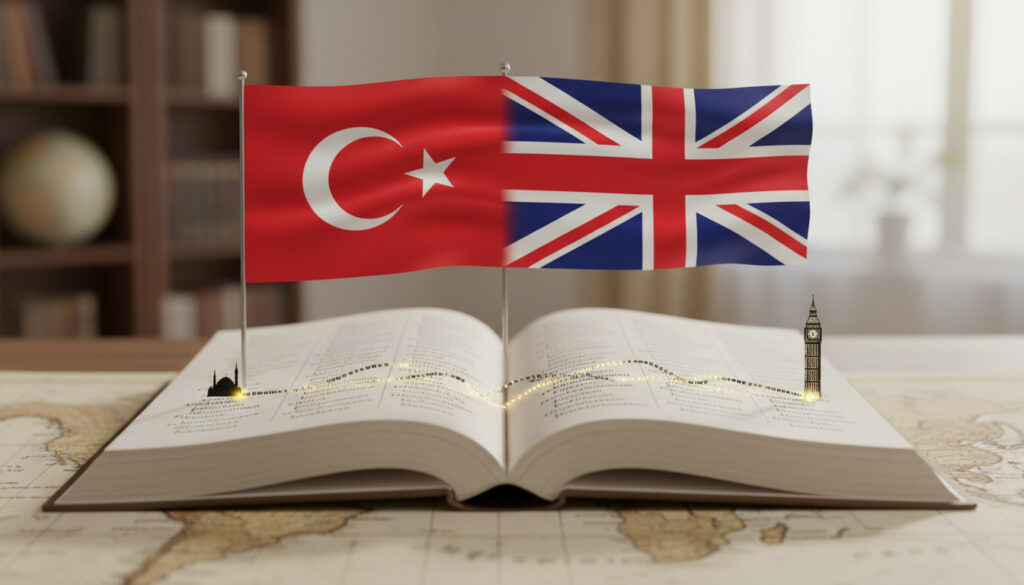
Turkish to English Translation – Accurate, Natural Results
The Structural Divide in Turkish-English Translation
Turkish and English sit at opposite ends of the typological spectrum. Turkish agglutinates meaning through extensive suffixation, embedding grammatical relationships directly into word stems. English, by contrast, relies on analytic structures and strict word order. This fundamental difference means that translation between the pair rarely proceeds word-for-word. A Turkish sentence might express what requires an entire English clause within a single compound word, while English nuances of tense and aspect often demand explanatory phrasing in Turkish. Professionals offering professional translation services must navigate these divergent logics while preserving register and intent.
Core Linguistic Parameters
Morphological Complexity
Turkish employs vowel harmony and consonant assimilation rules that affect how suffixes attach to stems. A translator must recognize when buffer letters (y, n, s) appear between morphemes and how voicing affects final consonants. These phonological processes have no English equivalent, requiring translators to unpack meaning methodically using resources like the Cambridge Turkish-English Dictionary for precise verification.
Syntactic Rigidity
English demands rigid subject-verb-object ordering. Turkish follows subject-object-verb patterns but allows scrambling for emphasis, provided suffixes maintain grammatical relationships. This flexibility creates localization challenges; a Turkish technical manual might place the action at the sentence’s end, while English conventions require immediate verbs for clarity.
Absence of Grammatical Gender
Turkish contains no gendered pronouns or articles. Translators rendering Turkish into English must infer gender from context, often requiring biological knowledge or cultural familiarity. Conversely, English gender markers disappear entirely in Turkish, sometimes necessitating additional descriptors to maintain clarity.
Critical Translation Challenges
The Turkish Language Association maintains that modern Turkish has streamlined significantly since the 1928 script reform, yet classical constructions persist in legal and diplomatic texts. Translators encounter obsolete Ottoman vocabulary, Persian and Arabic loanwords, and complex honorific systems absent in contemporary English. These historical layers demand specialized etymological knowledge alongside modern fluency.
Technical translation presents additional hurdles. Turkish computer terminology often borrows English terms phonetically, while engineering specifications rely on German or French cognates from earlier industrial periods. Consistency becomes paramount; a translator must choose between transliteration, neologisms, or descriptive equivalents based on audience expertise and industry standards.
| Linguistic Feature | Turkish Characteristics | English Characteristics | Translation Impact |
|---|---|---|---|
| Word Formation | Agglutinative; suffix chains | Analytic; isolated words | Word count expansion (typically 15-20%) |
| Verb Position | Final (SOV) | Medial (SVO) | Sentence restructuring required |
| Definiteness | Contextual; accusative case marker -ı/i/u/ü | Definite article “the” | Overt marking necessary in English |
| Formality | Second-person plural (siz) for respect | Auxiliary “would/could” | Register calibration essential |
| Evidentiality | Gerunds indicating information source (-mış) | Adverbs (“apparently”) | Explicit evidential markers needed |
Deep Structural Complexities
Buffer letters represent one of the most intricate mechanical aspects of Turkish morphology. When suffixes beginning with vowels attach to stems ending in vowels, a buffer ‘y’ intervenes. Compound nouns require buffer ‘s’ or ‘n’ depending on grammatical function. Translators working rapidly might overlook these insertions, altering case relationships and meaning. Professional workflows typically include separate verification stages for morphological accuracy before final editing.
The aorist tense (-ır/ir/ur/ür/ar/er) poses particular difficulty. Unlike English simple present, which describes habitual action or universal truth, the Turkish aorist conveys inclination, probability, or timeless fact depending on context. Literary translators spend considerable effort calibrating this aspect, as direct mapping to English present tense often flattens nuanced meaning into generic statements.
Evolution of the Translation Field
Prior to 1928, Turkish-English translators grappled with Ottoman Turkish written in Perso-Arabic script, replete with Arabic grammatical constructions and Persian vocabulary. The language reform initiated by Atatürk introduced the Latin alphabet and purged thousands of foreign loanwords, creating a standardized modern Turkish that aligned more closely with spoken forms. Early translators in this period functioned essentially as dual interpreters, bridging not just languages but scripts and literary traditions.
The 1990s saw increased demand for Turkish Turkish language technical documentation as Turkey expanded manufacturing exports. Translation memory tools emerged, though early systems struggled with Turkish’s morphological richness—stemmers could not reliably identify root words through suffix chains. Contemporary CAT tools have improved through better morphological analysis, yet human oversight remains non-negotiable for legal contracts and marketing materials.
Clarifying Common Misconceptions
Many assume that Turkish lacks grammatical complexity due to its regular vowel harmony rules and absence of gender. In reality, the language compensates through extensive verbal nouns, participles, and converbs that condense subordinate clauses into single words. An English relative clause (“the book that I read yesterday”) becomes a single agglutinated Turkish noun. Translators must expand these constructions carefully, ensuring that temporal and logical relationships remain explicit in English.
Double negation creates another pitfall. Turkish frequently uses negative concord, where multiple negative words reinforce a single negation. English prohibits such constructions, requiring content shifts from “I didn’t see nothing” (Turkish standard) to “I didn’t see anything.” Recognizing when Turkish intensifies negation versus when it creates litotes (understatement through double negative) separates competent translators from experts.
For learners seeking to understand these nuances, language resources provide essential foundational knowledge before attempting technical translation work.
Current Industry Dynamics
The American Translators Association notes that Turkish-English remains a high-demand language pair, particularly in finance, pharmaceuticals, and geopolitical analysis. Machine translation has improved for general domain content; neural machine translation platforms handle basic Turkish suffixation with increasing accuracy. However, evidential markers, cultural idioms, and register variation continue to challenge algorithmic systems.
Post-editing workflows have become standard for large-scale projects, though premium markets still demand human translation from the outset. The economics favor hybrid approaches: MT for initial drafts of repetitive technical content, with human specialists refining tone, checking morphological accuracy, and localizing cultural references. Quality assurance protocols now specifically test for false friends—words like “müdür” (manager) versus “mudur” (is it?), where diacritical marks alter meaning entirely.
Practitioner Insights
“The biggest mistake is treating Turkish like a code to be deciphered into English words. You have to understand the evidentiality—the speaker’s relationship to the information. When a Turkish CEO uses -mış, they’re not just saying something happened; they’re marking that they heard it secondhand. English requires you to add ‘apparently’ or ‘reportedly,’ or the entire political subtext vanishes.” For those needing to translate between Polish and Russian, consider this Перекладач з польської на російську.
— Senior Translator, Legal and Financial Division
This distinction between direct experience and reported information, grammaticalized in Turkish through the inferential past, requires constant attention. English relies on lexical choices and adverbials to convey similar nuances, forcing translators to make explicit what Turkish leaves morphologically implicit.
Key Considerations for Quality Output
Successful Turkish-English translation requires mastering the expansion factor—Turkish typically contracts information that English must spell out. Articles, prepositions, and subjects often materialize from nowhere in the target text. Conversely, English conciseness frequently demands expansion in Turkish to accommodate honorifics or evidential markers.
Verification standards should include back-translation checks for critical terminology and readability testing with target demographic samples. Utilizing Oxford Learner’s Dictionaries helps confirm English collocations when Turkish source terms lack direct equivalents. Ultimately, the goal remains invisible translation: rendering content that reads as though originally composed in the target language while preserving every semantic and pragmatic detail of the source.
Frequently Asked Questions
Why is Turkish-English translation more expensive than European language pairs?
The complexity stems from morphological processing requirements and the scarcity of qualified translators. Turkish agglutination means translation memory matches are lower than for Romance or Germanic languages, requiring more human processing time. Additionally, the language pair demands cultural expertise regarding both Ottoman historical references and contemporary Turkish business etiquette.
Can machine translation handle Turkish sufficiently for business use?
For internal communications and gist comprehension, modern neural MT provides adequate results. However, legal contracts, marketing materials, and medical documentation require human translation. Turkish evidential markers, suffix-driven case relationships, and context-dependent word formation currently exceed algorithmic reliability for high-stakes content.
How do Turkish honorifics translate into English?
Turkish uses second-person plural pronouns (siz) as formal address, often combined with title suffixes (-bey, -hanım). English must recreate this respect through register shifts, modal verbs (“would you mind”), or explicit titles (Mr./Ms./Dr.). The Turkish practice of using first names with honorifics (Ayşe Hanım) often becomes “Ms. Ayşe” or “Ms. [Surname]” in English, depending on cultural context.
What causes the word count expansion when translating Turkish to English?
Turkish compound words containing multiple suffixes often require separate English words for each grammatical function. A single Turkish word indicating “to their houses” (evlerine) expands to three words in English. Similarly, Turkish nominalizations require relative clauses in English, and evidential markers demand adverbial phrases. Standard expansion rates range from 15% to 25%.
More related posts
 Physical Therapy Near Me – NHS and Private UK Guide
 Christina Applegate Movies and TV Shows: Full Filmography
 How Did Mr. Krabs Die? The Full Death Theory Explained
 How Much Is a Pint? Sizes, ml, oz & Ireland Prices Explained
 Best Movies to Watch – Top Netflix Comedies 2025
 Is Baking Powder the Same as Baking Soda? Differences Explained
 Guardians of the Galaxy 3 – Release Date, Cast and Soundtrack Guide
 Play Kitchen Buying Guide 2025: Best Options in Ireland