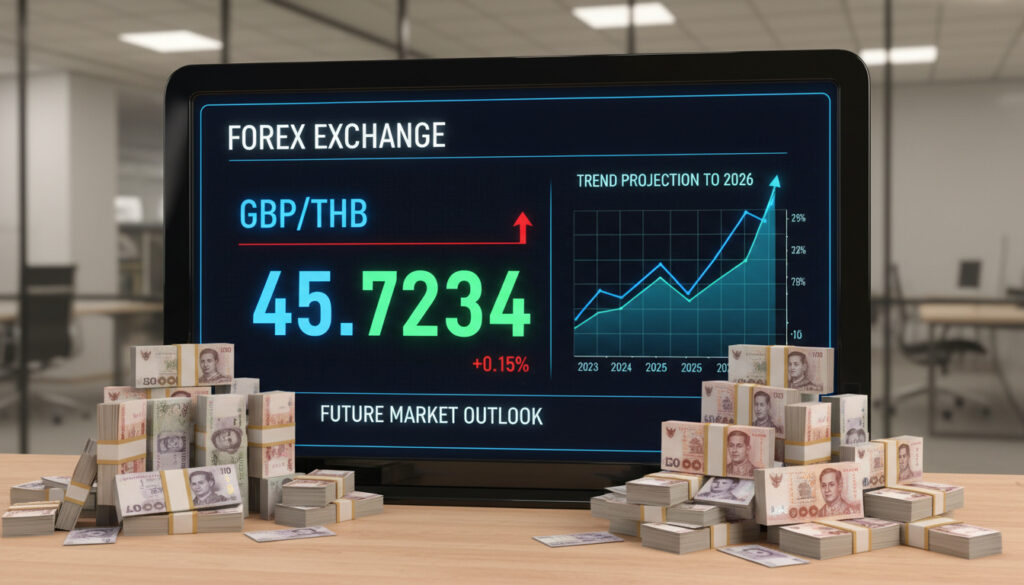
Pound to Thai Baht – Current Rate and 2026 Trends
The pound sterling currently trades at approximately 42.9 to 43.0 Thai baht in global mid-market conditions. This exchange rate matters for thousands of UK travellers heading to Thailand and for anyone sending remittances or conducting business between the two economies.
Recent data from currency platforms shows modest volatility in 2026, with the pair fluctuating between roughly 41.8 and 43.4 baht per pound since January. Understanding these movements requires looking at both Bank of England and Bank of Thailand policy signals, alongside tourism flows and broader risk sentiment.
This analysis examines live conversion rates, historical trends since the start of 2026, and the economic mechanisms driving valuations. It also evaluates practical options for exchanging currency, from high-street banks to digital multi-currency apps.
What is the Current 1 GBP to THB Exchange Rate?
1 GBP ≈ 42.9 THB
Steady near reference levels
42.34 – 43.81 THB
Mid-market reference ~42.92
Multiple data providers confirm sterling is trading near the 42.9 to 43.0 level against the baht. Wise lists the live rate at approximately 42.92 THB per pound, while Investing.com records 42.920 THB. AlanChand indicates a rounded figure of 42.9 THB. Revolut’s in-app snapshot showed 42.35 THB at the time of data collection, illustrating how retail rates can diverge from interbank benchmarks.
- The pair has declined approximately 2% over the past seven days.
- Volatility remains constrained within a 41.8 to 43.4 band throughout 2026.
- Mid-market rates represent the benchmark before provider margins.
- Weekend rates may include additional markups on certain retail platforms.
- Daily fixes from central banks serve as reference points, not tradable prices.
- Retail spreads typically range from 0.5% to over 4% depending on channel.
- Real-time fluctuations occur continuously during market hours.
| Amount (GBP) | Equivalent (THB) | Source/Metric |
|---|---|---|
| £1 | ฿42.92 | Wise mid-market |
| £10 | ฿429 | AlanChand indicative |
| £100 | ฿4,287 | Standard conversion |
| £1,000 | ฿42,867 | Reference calculation |
| 1 THB | £0.0233 | Reverse conversion |
| Weekly High | ฿43.81 | 7-day peak |
| Weekly Low | ฿42.34 | 7-day trough |
| 52-Week Range | 41.8 – 43.4 | 2026 trading band |
How Much is 100 GBP in THB Today?
At the current mid-market level of approximately 42.9 baht per pound, converting one hundred pounds yields around 4,287 Thai baht. This figure represents the benchmark rate before any provider margins or transaction fees.
Smaller Denominations
Ten pounds converts to roughly 429 baht at present rates. These smaller conversions matter for taxi fares, street food, and incidental purchases where card acceptance may be limited.
Larger Transfers
One thousand pounds equates to approximately 42,867 baht based on recent indicative data. When transferring such sums, the choice of provider becomes critical; a 3% spread difference equals nearly 1,300 baht in lost value.
Reverse Calculation
Single baht units convert to approximately 0.0233 pounds sterling, or just over two pence. This inverse relationship helps Thai exporters and UK importers calculate costs in their respective home currencies.
What is the Historical GBP to THB Exchange Rate?
Sterling has traded within a defined band against the baht throughout 2026. Examination of ECB-based daily fixes and spot rate histories reveals a range-bound market with periodic volatility spikes.
Weekly Performance Metrics
Data indicates the past week saw highs near 43.81 THB and lows of 42.34 THB, averaging around 43.5 THB. The pair has softened approximately 2% from levels observed seven days prior.
Year-to-Date Volatility
January 2026 opened with rates between 41.7 and 43.4 THB per pound. February witnessed the year’s peak at 43.40 THB on 4 February, followed by a trough of 41.86 THB on 23 February according to ECB-based historical data. Early March settled into the low 42-range, with ExchangeRates.org.uk recording 41.8464 THB on 1 March.
Why Does the Pound to Thai Baht Rate Change?
Currency valuation between the United Kingdom and Thailand reflects divergent monetary policies, inflation trajectories, and external demand factors. No single indicator determines the cross; rather, a composite of macroeconomic signals drives institutional flows.
Interest Rate Differentials
The spread between Bank of England policy rates and Bank of Thailand benchmarks creates yield attractions. When UK rates rise relative to Thai rates, sterling typically strengthens, though this relationship fluctuates with forward guidance.
Thailand’s current account remains sensitive to tourism inflows. Strong global travel demand typically supports the baht as foreign visitors exchange currency for local services.
Inflation and Growth Dynamics
Higher UK inflation relative to Thailand can erode sterling’s purchasing power over time. Markets price expected central bank reactions to these differentials, often before official policy shifts occur.
Thai baht is often categorized alongside other Asian emerging market currencies. This classification means it can experience sharper moves during global uncertainty compared to major reserve currencies.
Risk Sentiment and Capital Flows
The baht functions as an emerging market Asian currency. During “risk-off” episodes, capital may exit emerging markets, potentially weakening the THB against sterling. Conversely, “risk-on” phases tend to support the baht.
Precise numerical forecasts for GBP/THB are not available from public reference sites. Standard macroeconomic relationships suggest directional biases, but exact future rates remain uncertain and subject to unscheduled policy shifts.
Where to Get the Best GBP to THB Exchange Rate?
Execution matters as much as timing. The spread between mid-market rates and consumer-facing prices varies dramatically by provider type, often exceeding 4% at traditional banks.
Digital Multi-Currency Platforms
Wise offers conversions near the mid-market rate with transparent fees, while Revolut provides interbank-level pricing on weekdays, though weekend markups may apply. These platforms typically outperform legacy banks by 2% to 3% on total cost.
Traditional Banking Channels
UK high-street banks typically apply spreads 2% to 4% worse than mid-market, plus fixed wire fees. Thai banks offer walk-up cash exchange often 1.5% to 3% off the reference rate.
Avoiding Tourist Traps
Airport kiosks and hotel desks routinely charge 5% to 10% above mid-market rates. These should be reserved for emergency liquidity only.
When evaluating international purchasing power, it is useful to compare sterling’s performance across multiple corridors. For context on euro-sterling valuations, see 2000 Euros in Pounds – Live Rate and 2026 Trends.
GBP to THB Rate Timeline: 2026 Key Data Points
- : Rate peaks at approximately 43.40 THB per GBP (source)
- : Trough recorded at roughly 41.86 THB
- : Daily spot fixes at 41.8464 THB per pound (source)
- : Stabilization between 42.18 and 42.29 THB
- : Trading near 42.9 THB
Established Facts vs. Uncertain Projections
| Established Information | Information That Remains Unclear |
|---|---|
| Current mid-market rate ~42.9 THB | Precise forward rates for next quarter |
| 2026 trading range 41.8–43.4 | Exact timing of future BoE/BoT policy shifts |
| Weekly volatility measured at -2% | Short-term speculative capital flows |
| Official daily reference rates published | Exact retail spreads at unspecified venues |
| Dynamic Currency Conversion increases costs | Future tourism recovery velocity |
The Economic Context Behind the Rate
The exchange rate reflects the relative economic health of two distinct systems. The United Kingdom maintains a services-oriented, financial-centric economy with substantial outbound tourism and investment flows. Thailand relies heavily on export manufacturing, agricultural commodities, and inbound tourism receipts.
When UK economic data surprises to the upside—whether through services PMI or inflation prints—the pound often finds support. Conversely, robust Thai export figures or surging tourism arrivals can strengthen the baht independent of UK developments. These cross-currents create the observed volatility within the 41.8 to 43.4 band rather than a linear trend.
Data Sources and Official References
The Bank of England publishes daily reference exchange rates for sterling against major currencies, providing the benchmark used by UK financial institutions for valuation and accounting purposes.
Bank of England Statistical Releases
The Bank of Thailand provides daily reference rates for the baht against key international currencies, derived from interbank market activity and used as the official benchmark for commercial banks.
Bank of Thailand Exchange Rate Statistics
Live rate data cited from Wise, Investing.com, AlanChand, and Revolut reflect mid-market or indicative retail pricing at specific timestamps. Historical data derives from ECB-based feeds via FreeCurrencyRates and ExchangeRates.org.uk. XE provides additional charting tools for visualizing longer-term trends.
Summary: Key Considerations for Sterling to Baht Conversion
The pound currently buys approximately 42.9 Thai baht in mid-market conditions, though retail rates vary significantly by provider. Historical data shows the pair has traded between 41.8 and 43.4 throughout 2026, with recent weekly declines of roughly 2%. Travellers and remittance senders should prioritize multi-currency digital platforms over airport kiosks, always selecting local currency charges to avoid Dynamic Currency Conversion fees. For broader market context affecting global risk appetite, monitor the S&P 500 Live – Current Value, Chart and Insights as equity sentiment indirectly influences emerging market currency valuations.
Frequently Asked Questions
Is the Thai baht stronger than the pound?
No. One pound converts to approximately 43 baht, meaning sterling commands significantly more purchasing power than the baht in nominal terms.
How to send money from GBP to THB?
Use specialist platforms like Wise or Revolut for mid-market rates, or compare total costs including fees across FX brokers and traditional banks.
Why do rates differ between Wise and my bank?
Banks typically add a margin of 2-4% above the mid-market rate, while Wise charges a transparent, lower percentage fee closer to the real exchange rate.
What is Dynamic Currency Conversion?
DCC occurs when foreign terminals offer to charge your card in your home currency. This service usually includes poor exchange rates and should be declined in favor of local currency.
Can I lock in a rate for future travel?
Some FX brokers offer forward contracts for large sums, fixing today’s rate for future delivery. Retail apps rarely offer this for small amounts.
How often do GBP/THB rates change?
Continuously. The foreign exchange market operates 24 hours on weekdays, with rates updating every few seconds during active trading.
Are airport exchange rates really that bad?
Yes. Airport kiosks routinely embed 5-10% margins above mid-market rates, making them the most expensive option for obtaining baht.
More related posts
 Sky Contact Number 0333: Customer Service Helpline
 Motte and Bailey Castle: History, Design & Examples
 Technics EAH-AZ100 Review: Worth It? Vs AirPods, Bose
 Here Comes the Sun – Lyrics, Meaning, Chords & Facts
 Households Outdoor Lights Advice: Mistakes, Rules & Tips
 Ella-Mae Rayner – Fatal Birmingham Dog Attack Details
 7 Seater Cars for Sale in Ireland: Best Deals & Used Options
 Kingdom Come Deliverance 2: Map, Reviews, Release