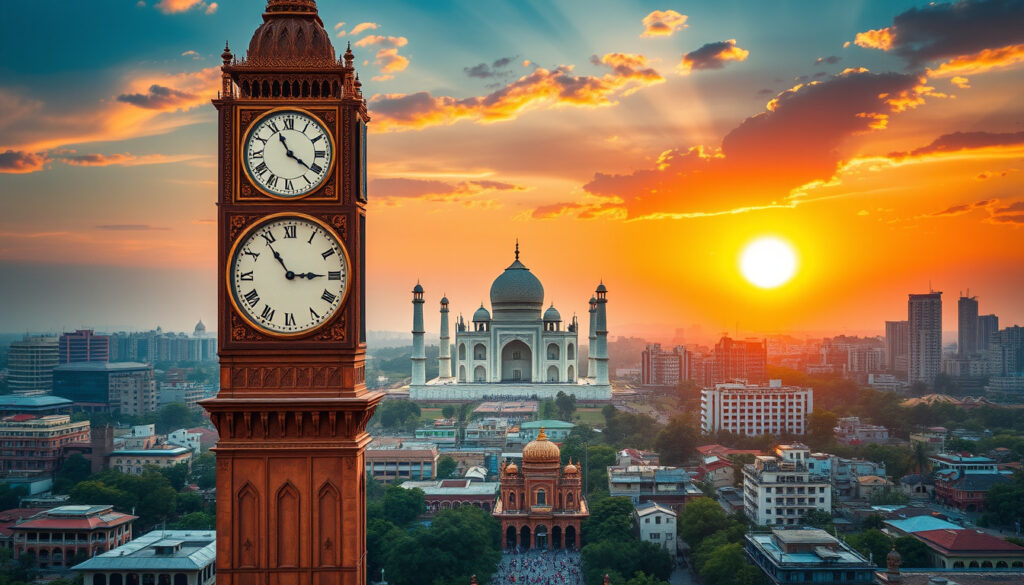
Current Time in India Now – IST Live Clock & Cities
India stretches more than 1,800 miles from its western coast to its eastern tip, yet every corner of the country runs on the same clock. That single time zone — Indian Standard Time, set at UTC+5:30 — covers everything from the financial pulse of Mumbai to the bureaucratic rhythm of New Delhi. This article breaks down exactly how India’s timekeeping works, where the major cities stand right now, and why a half-hour offset has quietly shaped international scheduling for decades.
Time Zone: India Standard Time (IST) ·
UTC Offset: +05:30 ·
DST Observed: No ·
Major Cities: Mumbai, New Delhi, Bengaluru ·
Time Format Options: 12-hour AM/PM, 24-hour
Quick snapshot
- India uses one time zone: IST UTC+5:30 (Wikipedia – Indian Standard Time)
- No DST since 1945 (Time.is – Time in Mumbai)
- Adopted on 1 January 1906 (Wikipedia – Indian Standard Time)
- Whether renewed calls for regional time zones will gain traction
- Specific economic data on solar-time mismatches in eastern India
- 1945: Mumbai drops daylight saving time (Time.is – Time in Mumbai)
- 1948: Kolkata drops Calcutta Time (Wikipedia – Indian Standard Time)
- 1955: Mumbai drops Bombay Time (Wikipedia – Indian Standard Time)
- IST remains stable as no DST legislation is pending (Wikipedia – Indian Standard Time)
- International schedulers must continue accounting for +5:30 offset (XConvert – India Time Converter)
The table below summarizes the key parameters defining Indian Standard Time.
| Attribute | Value |
|---|---|
| Standard Time | India Standard Time (IST) |
| UTC Offset | +05:30 hours |
| Observes DST | No |
| Geographic Span | One zone for 3.2 million sq km |
| Population Affected | 1.4 billion |
Does India have two time zones?
India does not have two time zones. Indian Standard Time is the sole time zone for the entire country, spanning more than 1,800 miles (2,900 km) from the Arabian Sea to the Bay of Bengal. The standard meridian at 82°30’E passes through Mirzapur, Uttar Pradesh, and dividing 82.5° by 15° gives a 5.5-hour offset from UTC — the basis of today’s UTC+5:30 designation.
That half-hour offset is important for international scheduling because New Delhi does not align exactly with whole-hour zones like London or Dubai, so meeting times often need more careful coordination than a simple one-hour comparison. The IANA identifier for India’s time zone is Asia/Kolkata, used by digital systems worldwide.
India’s single clock creates a daily solar-time tax on both extreme east and extreme west. Gujarat residents start work by torchlight in winter; Assam students begin school before dawn. The unified zone that simplifies national scheduling imposes practical inequities across 1,800 miles.
Historical proposals for multiple zones
The conversation about splitting India into time zones has surfaced periodically. Proposals have suggested separate zones for eastern states, where solar noon arrives significantly later than in the west. Supporters argue that residents in Arunachal Pradesh, for instance, would benefit from their own clock that better matches sunrise and sunset. Critics counter that a split would fracture national scheduling — rail timetables, banking systems, and broadcast networks all depend on a single reference.
Current single IST usage
As of now, no legislation or formal proposal to create multiple time zones has advanced in Parliament. IST is used for business, government, rail, aviation, and most digital scheduling systems in India. The National Physical Laboratory of India maintains IST with assistance from the Allahabad Observatory, ensuring the country stays locked to UTC+5:30 year-round.
“Using one time zone for the country, which spans more than 1,800 miles (2,900 km) from east to west, ensures standardization between cities that have huge variations in their local solar schedules.”
— Britannica, Encyclopedia publisher
The pattern is clear: despite the country’s massive east-west footprint and a sunrise gap of nearly two hours between Gujarat and Arunachal Pradesh, political and logistical convenience has kept India on one clock for over a century.
Is it AM or PM in India now?
India runs on 12-hour AM/PM time like the United States and most of South Asia, not the 24-hour military format sometimes used in European or aviation contexts. IST in military and aviation designation is written as E* (Echo-Star), but for civilian use, Indians switch between morning/afternoon labels just as Americans do.
The clock stays on UTC+5:30 all year, so there are no seasonal shifts to account for when planning recurring calls or travel itineraries. Whether it is 9 AM or 9 PM in New Delhi, the offset from your own time zone remains constant: 5 hours and 30 minutes ahead of GMT, and 9 hours and 30 minutes ahead of New York (Time.is – Time in Mumbai).
IST is 10 hours and 30 minutes ahead of New York during standard time, but the half-hour difference means callers must adjust precisely — a 3 PM London call translates to 8:30 PM in Mumbai, not a clean 8 PM.
Live AM/PM clock for IST
Current time in India:
12-hour vs 24-hour formats
Both formats are used in India depending on context. Digital watches, mobile phones, and casual conversation typically default to 12-hour AM/PM. Government schedules, rail timetables, and military communications often use 24-hour format to eliminate ambiguity. The user’s device settings usually determine which display appears — the underlying offset remains UTC+5:30 regardless (XConvert – India Time Converter).
Anyone scheduling a call between London and Mumbai needs to add 5 hours 30 minutes to GMT — not a clean 5-hour or 6-hour jump. Miss that half-hour and your 3 PM London call becomes a 8:30 PM Mumbai start.
The half-hour offset in IST means that international schedulers must always account for this asymmetry. Unlike whole-hour zones where a simple mental math works, India’s +5:30 requires precise calculation for every meeting time.
What time is it in Mumbai, New Delhi?
Mumbai and New Delhi share the same clock. Every city in India — from Kolkata to Chennai to Bengaluru — runs on IST UTC+5:30. There is no city-specific time zone within India; the entire country synchronized decades ago, with Mumbai dropping its local Bombay Time only in 1955 and Kolkata holding out until 1948.
As of right now, the live IST clock shows the same time in Mumbai and New Delhi alike. New Delhi is a common reference point for international meetings involving Indian teams because it is the capital, but Mumbai hosts the financial sector and both cities are mechanically synchronized to the same second.
The National Physical Laboratory of India maintains IST with atomic clock references, ensuring every city from Mumbai to Chennai stays synchronized to within fractions of a second of UTC+5:30.
Current time in major Indian cities
The table below shows the current time across India’s major cities, all displaying identical IST.
| City | Current IST |
|---|---|
| New Delhi | — |
| Mumbai | — |
| Bengaluru | — |
| Kolkata | — |
| Chennai | — |
Uniform IST across cities
Major cities in the IST timezone include Delhi, Bangalore, Kolkata, and Chennai, all displaying identical time. The rationale for this uniformity traces to the British era: a unified clock simplified railway scheduling across a subcontinent that had previously fragmented into dozens of local solar times. India spans more than 1,800 miles east to west, and using one time zone for the country ensures standardization between cities that have huge variations in their local solar schedules.
The implication: eastern India effectively runs “late” relative to its solar time — sunrise in Kolkata comes roughly 30 minutes before sunrise in Gujarat, yet both use the same clock. Westerners lose morning light; easterners gain evening hours. The trade-off has never been officially revisited.
Mumbai is the largest city in the IST timezone with a population of approximately 12.7 million people, and the financial capital sits in the west where IST creates a daily disconnect from solar time. The city’s 3 PM trading close aligns with 7:30 AM GMT, making Mumbai’s market window fit awkwardly between London and Tokyo sessions.
Which country has the most time zones?
France holds the record with 12 time zones — not metropolitan France alone, but the combined span of its overseas departments and territories from Guadeloupe in the Caribbean to Réunion in the Indian Ocean. Russia comes second with 11 time zones covering its enormous landmass from Kaliningrad to Kamchatka. The United States manages 11 zones if territories like Puerto Rico and Guam are included, or 9 for the contiguous states alone.
No country exceeds 12 zones. The answer depends on whether you count overseas territories as part of a nation’s administrative span. France’s global reach through territories like French Polynesia and New Caledonia keeps its zone count highest by most international standards.
France’s 12 zones come from territories across five oceans, while Russia’s 11 zones span a continuous landmass. India, with a single zone, sits at the opposite end of the spectrum from both countries.
Russia leads with 11 zones
Russia stretches across roughly 9,000 kilometers from its western edge to its eastern tip, crossing every major longitudinal band from Kaliningrad (UTC+2) to Kamchatka (UTC+12). In 2010, Russia consolidated from 11 to 9 time zones, then expanded back to 11 in 2016 after public backlash. The country’s sheer geographic scale makes it the textbook example of why longitudinal span matters for time zone count.
“Russia stretches across roughly 9,000 kilometers from its western edge to its eastern tip, crossing every major longitudinal band from Kaliningrad to Kamchatka.”
— Encyclopedia Britannica, Geographic reference
France with 12 across territories
France’s 12 zones come from territories like Martinique, Guadeloupe, French Guiana, Réunion, Mayotte, New Caledonia, French Polynesia (with five separate zones across its islands), Saint Pierre and Miquelon, and Wallis and Futuna. Metropolitan France itself uses CET (UTC+1), but the aggregate count across all French-administered lands wins the global title.
Most people think Russia has the most time zones — and geographically, it does for continuous landmass. But when territory count includes every administered land, France claims the record. India, with a single zone, sits at the opposite end of the spectrum from both countries.
The implication: when calculating global scheduling impacts, France’s scattered time zones create complexity that continuous-zone countries like Russia do not face. International businesses must account for France’s multi-oceanic time footprint differently than Russia’s east-west corridor.
Does India have 3 time zones?
India does not have 3 time zones. This claim circulates periodically, often confused with proposals rather than actual policy. India standardized to one IST in the early 20th century and has never legislated multiple zones. The confusion likely stems from two sources: past local times in major cities (Bombay Time, Calcutta Time) that persisted well into the 20th century, and ongoing academic discussions about whether a second zone would benefit eastern states.
The conversations about three zones have never resulted in legislation. The government has consistently maintained that logistical complexity — rail coordination, national broadcasting, banking networks — outweighs any benefit to regional solar alignment.
India’s IANA database entry is Asia/Kolkata — a single identifier for a single zone. The three-zone narrative confuses India with countries like Australia (which has three continental zones) or the United States (which has five mainland zones).
Myths vs reality of Indian zones
A persistent myth holds that India secretly operates on three zones or that a three-zone system is “coming.” Neither is true. The three-zone narrative sometimes confuses India with countries like Australia (which has three continental zones) or the United States (which has five mainland zones). India’s official IANA database entry is Asia/Kolkata — a single identifier for a single zone.
Single zone despite geography
India spans nearly 30° of longitude from its western coast to its eastern tip — enough for roughly two full hours of solar time difference. Yet no administrative division exists. The standard meridian at 82°30’E was chosen to split the difference: western India operates “early” relative to its solar time, and eastern India operates “late.” The result is a daily mismatch of roughly 60–90 minutes between clock time and solar time for most of the population.
Why this matters: the single time zone means a farmer in Gujarat and a student in Assam both start their day at 6 AM IST regardless of where the sun sits. For the farmer, that means working by torchlight in winter mornings; for the student, it may mean starting school before dawn in eastern states. The geographic equity of a single clock creates practical inequities by region.
Using one time zone across 1,800 miles means sunrise in Gujarat can be around 6:45 AM while sunrise in Arunachal Pradesh hits around 4:30 AM — yet both regions reset their clocks to 6:00 AM. The single zone that unifies India’s national scheduling imposes a daily solar-time tax on both the extreme east and extreme west.
The consequence: eastern India loses productive morning hours to artificially early clock time, while western India sacrifices evening daylight. Neither region can optimize its daily schedule around the sun without government intervention that has never materialized.
Related reading: Mumbai Indians vs Gujarat Titans
en.wikipedia.org, utctime.net, zeitverschiebung.net, rashidfaridi.com
For precise IST tracking across cities like Mumbai and Delhi, many rely on the India Time Now clock featured on specialized sites.
Frequently asked questions
What is India time zone?
India’s time zone is called Indian Standard Time (IST), designated as UTC+5:30. It is maintained by the National Physical Laboratory of India with assistance from the Allahabad Observatory. The IANA identifier for this zone is Asia/Kolkata.
Current time in India with seconds?
The live clock above displays Indian Standard Time with full precision, including seconds. IST runs five hours and thirty minutes ahead of GMT with no seasonal adjustments — the same 5:30 offset applies every day of the year.
India time in 12 hour format?
India uses 12-hour AM/PM format for civilian timekeeping, just like the United States. Morning hours display as 12 AM through 11:59 AM, and afternoon hours run 12 PM through 11:59 PM. The underlying offset from UTC remains constant at +5:30 regardless of display format.
Current time in India GMT?
Indian Standard Time is 5 hours and 30 minutes ahead of Greenwich Mean Time (GMT). When it is noon in London, it is 5:30 PM in India. This half-hour offset is distinctive — most time zones use whole-hour differences, making India’s +5:30 offset stand out in international scheduling.
India time in 24 hour format?
India supports 24-hour format in official and military contexts. In 24-hour format, IST runs from 00:00 (midnight) to 23:59 (one minute before the next midnight). Rail timetables, government schedules, and aviation communications typically use this format to eliminate AM/PM ambiguity.
How to convert current time in India?
To convert from IST to your local time: add or subtract the hour difference between your zone and UTC+5:30. For New York (EST = UTC-5), India is 10 hours and 30 minutes ahead. For London (GMT), India is 5 hours and 30 minutes ahead. For Sydney (AEST = UTC+10), India is 4 hours and 30 minutes behind. The half-hour always stays constant.
Time with seconds live in India?
The live IST display above updates every second, showing the precise current time in India including seconds. The National Physical Laboratory of India maintains timekeeping accuracy with atomic clock references, ensuring IST stays synchronized to within fractions of a second of UTC+5:30.
More related posts
 British Birds of Prey: Complete Identification Guide
 Sassuolo vs SSC Napoli Lineups – Confirmed Teams and Stats
 Cast of The Pitt – Meet the ER Doctors and Nurses
 When Is Ramadan 2026? Start, End Dates & Fasting Times
 The Polar Express Train Ride: 2026 Locations, Prices & Reviews
 Tiger Shroff: Age, Height, Net Worth, Girlfriend, Career
 Lili Reinhart: Biography, Relationships, and Health
 Ryan Trahan: Net Worth, Wife, LGBTQ Support, Mom’s Jail