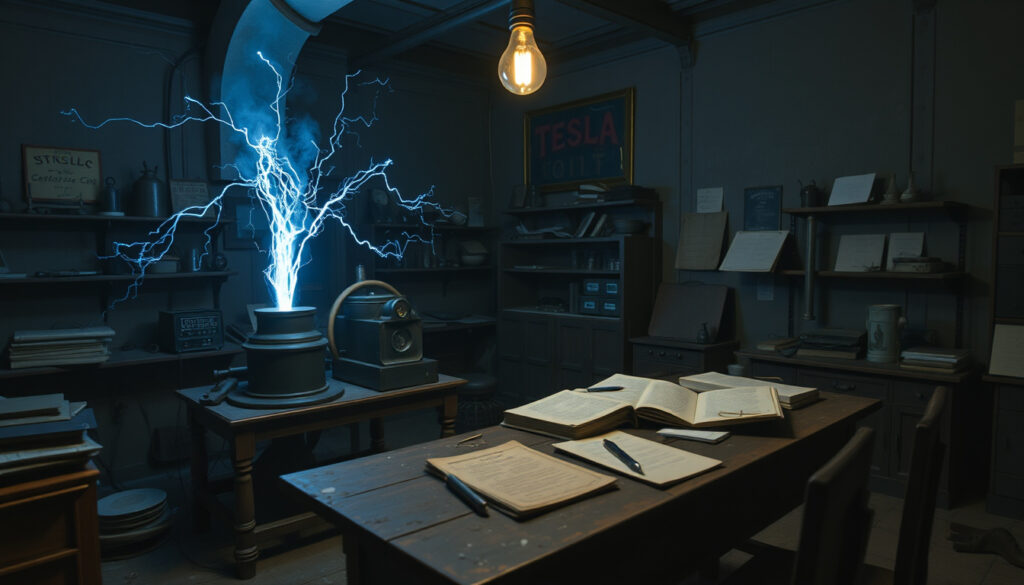
Nikola Tesla: Tragic Story, Inventions, Death, and Legacy
Few inventors shaped the modern world as profoundly as Nikola Tesla, yet few died as alone and forgotten. His alternating current system powers homes and industries across the globe, but during his final years he could barely afford his hotel bill.
Born: 10 July 1856, Smiljan, Austrian Empire (modern-day Croatia) ·
Died: 7 January 1943, New York City, United States ·
Key invention: Alternating current (AC) system ·
U.S. patents: More than 300 ·
Net worth at death: Nearly zero (died in debt)
Quick snapshot
- Invented the AC induction motor (patent 1888) (Encyclopaedia Britannica)
- Died on 7 January 1943 in New York City (All That’s Interesting)
- Never married, no known children (The Franklin Institute)
- Exact last words (multiple contradictory accounts)
- Precise IQ (no test administered)
- Whether Tesla or Marconi invented radio first (Tesla’s patents later upheld)
- 1888: Demonstrates AC motor with Westinghouse
- 1900–1905: Wardenclyffe Tower attempt at wireless transmission
- 1943: Dies alone in Hotel New Yorker
- Ongoing revival of Tesla’s reputation in pop culture
- Museum at Wardenclyffe site (Tesla Science Center)
- Electric vehicle company Tesla, Inc. keeps his name current
Seven key facts, each grounded in primary or secondary sources:
| Attribute | Value |
|---|---|
| Full name | Nikola Tesla |
| Birth | 10 July 1856 |
| Death | 7 January 1943 |
| Nationality | Serbian-American |
| Known for | Alternating current system, Tesla coil |
| Patents | Over 300 worldwide |
| Net worth at death | Less than $10,000 (debt) |
What is the tragic story of Nikola Tesla?
Early promise and Edison fallout
Tesla arrived in the United States in 1884 with little more than a letter of recommendation from his previous employer in Europe. He briefly worked for Thomas Edison, but the partnership soured over a fundamental disagreement: Tesla championed alternating current (AC), while Edison backed direct current (DC). The so-called War of the Currents began. Endesa notes that the two men represented competing visions for electricity’s future—and Edison was not above publicly electrocuting animals to discredit AC.
Tesla found a ally in George Westinghouse, who licensed his AC patents in 1888. The Westinghouse partnership gave Tesla the resources to build the world’s first AC power plant at Niagara Falls, but it also set the stage for his financial undoing.
Financial decline and forgotten years
After the success of the AC system, Tesla turned to even more ambitious projects: wireless electricity transmission, global communication, and a death ray. He built Wardenclyffe Tower in 1901 on Long Island, financed by J.P. Morgan. When Morgan pulled funding after learning the tower could transmit power wirelessly—undermining his copper wire investments—the project collapsed.
From that point, Tesla never recovered financially. He lost control of his patents, and many of his later inventions remained conceptual. By the 1910s he was living in hotels, moving from room to room when he could no longer pay the bill. All That’s Interesting reports that his final years were marked by increasing isolation and poverty.
Death alone in poverty
Tesla died of coronary thrombosis on 7 January 1943, alone in Room 3327 of the Hotel New Yorker in New York City. He was 86 years old. A housekeeper discovered his body two days later. His net worth at death was less than $10,000, and he left behind a mountain of unfulfilled patent royalties.
Tesla’s alternating current system now lights every major city on earth, but he died deeply in debt. The man who enabled the electric age couldn’t afford to pay his hotel bill.
Two titans, one bitter rivalry—the differences go deeper than AC versus DC.
| Aspect | Nikola Tesla | Thomas Edison |
|---|---|---|
| Birth | 1856, Smiljan, Austrian Empire (Croatia) | 1847, Milan, Ohio, USA |
| Key invention | AC motor, Tesla coil, wireless power concepts | Phonograph, practical incandescent light, motion picture camera |
| Business approach | Idea-first, poor at monetizing patents | Aggressive patenting, built commercial systems |
| Wealth at death | Nearly zero (in debt) | ~$12 million (equivalent ~$200M today) |
| Public recognition | Forgotten at death; posthumous revival | Celebrated during life and after |
| Legacy | Foundation of modern AC power grid | Founder of the first industrial R&D lab |
The implication: Edison’s empire was built on systematizing and selling inventions; Tesla’s was built on pure discovery without a business firewall. One became a household name, the other a cautionary case study.
What is Nikola Tesla most famous for?
Alternating current system
Tesla’s most transformative contribution is the polyphase alternating current (AC) system, which enables efficient long-distance power transmission. He developed the rotating magnetic field, a principle that made AC motors possible, and patented the induction motor in 1888. Encyclopaedia Britannica states that this work is the foundation of modern electrical power distribution.
Tesla coil
In 1891 Tesla invented the Tesla coil, a high-voltage, high-frequency transformer that remains a staple in radio engineering and educational demonstrations. The Franklin Institute describes it as an important experimental device that advanced early radio transmission.
Wireless transmission experiments
Tesla dreamed of a world without wires. In 1898 he demonstrated a wireless-controlled boat—an early prototype of remote control. At Wardenclyffe, he attempted to broadcast power and communication signals globally, though the project was never completed. His vision of a global wireless grid was decades ahead of its time.
Every time you flip a light switch or plug into a wall outlet, you are using a system that Tesla designed in the 1880s. His AC grid is the invisible backbone of the modern era—yet he never collected a cent from it.
Who is Elon Musk to Nikola Tesla?
No blood relation
Despite persistent internet rumors, Elon Musk and Nikola Tesla are not related by family. Tesla never married and had no children, so no direct descendants exist. The Franklin Institute confirms Tesla remained celibate his entire life.
Musk named Tesla Motors after the inventor
In 2003, Martin Eberhard and Marc Tarpenning founded Tesla Motors (now Tesla, Inc.) and named it after Nikola Tesla to honor the inventor’s electric motor breakthroughs. Elon Musk joined later as an investor and chairman. The name is a deliberate homage—one that keeps Tesla’s legacy alive in public consciousness.
Shared vision of sustainable energy
Both men championed the idea of a world powered by clean electricity. Musk has frequently cited Tesla as an inspiration, and the company’s mission—accelerating the world’s transition to sustainable energy—mirrors Tesla’s own ambitions for wireless power and renewable sources.
Elon Musk is worth hundreds of billions; Nikola Tesla died with under $10,000. The gap is a stark reminder that commercial execution—not visionary genius alone—determines financial legacy.
What were Nikola Tesla’s final words?
Multiple accounts exist, but none are confirmed by a primary source. The most frequently repeated version is that Tesla squeezed a nurse’s hand and said “I love you too.” Another account claims he had no recorded last words. All That’s Interesting notes the uncertainty: the hotel staff found him dead, and no official record of his final moments was preserved.
What did Einstein say about Nikola Tesla?
Albert Einstein reportedly called Tesla “a great inventor” but also “a poor businessman.” The quote appears in several biographies, though its exact origin is difficult to verify. Tesla, for his part, was skeptical of relativity and publicly dismissed Einstein’s theories. Despite their mutual respect, the two physicists had fundamentally different views of the universe.
Are there any living descendants of Nikola Tesla?
Tesla never married and had no known children, legitimate or illegitimate. He stated in his later years that he considered celibacy essential for his work. No direct living descendants exist. Claims of alleged grandchildren or great-nephews are unverified and widely dismissed by historians.
Who is the 1st trillionaire?
As of 2025, no one has reached a net worth of one trillion dollars. Elon Musk, Jeff Bezos, and Bernard Arnault are among the leading candidates. The comparison is ironic: Tesla, whose inventions underpin the entire electric economy, never accumulated significant wealth. His net worth at death was less than $10,000—a fraction of what even a single patent royalty would be worth today.
Timeline of Nikola Tesla’s Life
- 1856 – Born in Smiljan, Austrian Empire (now Croatia)
- 1884 – Moves to the United States, works for Thomas Edison
- 1888 – Demonstrates AC motor; forms partnership with Westinghouse
- 1891 – Invents the Tesla coil; becomes U.S. citizen
- 1900–1905 – Builds Wardenclyffe Tower in attempt at wireless transmission
- 1910s – Financial decline; loses control of patents
- 1943 – Dies alone in Hotel New Yorker, New York City
The pattern: Tesla’s trajectory peaks early with AC, then steadily declines as he chases ever grander ideas without a business partner to ground them.
Confirmed facts
- Tesla invented the AC induction motor (patent 1888) (Encyclopaedia Britannica)
- He died on 7 January 1943 in New York City
- He never married and had no known children
- Tesla Coil patent granted in 1891
What’s unclear
- Exact last words (multiple contradictory accounts)
- His precise IQ (no test was administered)
- Alleged lost inventions (some filed patents may be apocryphal)
- Whether he or Marconi invented radio first (Tesla’s patents upheld later)
In their own words
“I don’t care that they stole my idea… I care that they don’t have any of their own.”
— Nikola Tesla (attributed, source uncertain)
“He is a great inventor, but he is a poor businessman.”
— Albert Einstein (various biographies)
“Tesla is a great inventor, but he doesn’t know how to turn his inventions into money.”
— Thomas Edison (apocryphal)
Nikola Tesla’s life is not just a biography of a scientist—it’s a lesson in the economics of invention. His AC system powers the world, but he died in debt because he never built a business around it. For today’s innovators, the choice is clear: either partner with commercial forces from the start, or risk the same fate. Tesla’s story is a reminder that genius alone does not guarantee dignity—or a home.
britannica.com, biography.com, study.com, invention.si.edu, curiosityu.com, youtube.com, thomasedison.org, en.wikipedia.org, en.wikipedia.org
For a deeper look into Nikola Tesla’s tragic story and inventions, visit Nikola Teslas tragic story and inventions which also debunks common IQ myths surrounding the inventor.
Frequently asked questions
Did Nikola Tesla have a wife or children?
No. Tesla never married and had no children. He considered celibacy necessary for his work.
How did Nikola Tesla die?
He died of coronary thrombosis on 7 January 1943, alone in Room 3327 of the Hotel New Yorker.
What was Nikola Tesla’s IQ?
No official IQ test was ever administered. Anecdotal estimates range from 160 to 210, but these are speculative.
Did Nikola Tesla and Thomas Edison work together?
Yes, briefly in 1884 after Tesla arrived in the U.S. The partnership ended over disagreements about AC vs. DC power.
Is Nikola Tesla related to Elon Musk?
No. Elon Musk is not related to Nikola Tesla. Tesla had no children, so no direct descendants exist.
Why did Nikola Tesla die poor?
He lost control of his patents, failed to commercialize his later inventions, and was outmaneuvered by businessmen like Edison and J.P. Morgan.
What is a Tesla coil?
A high-voltage, high-frequency transformer invented in 1891, used in radio and electrical experiments.
Did Nikola Tesla predict the future?
Tesla foresaw wireless communication, drone technology, and global power grids. Many of his predictions turned out to be prescient.
More related posts
 Weather Newton-le-Willows: 7-Day Forecast, Warnings & Hourly
 Rayna Vallandingham: Cobra Kai Actress & Tae Kwon Do Champion
 North Lakes Hotel and Spa: Penrith 4-Star Spa Hotel Guide
 Karl Howman: Biography, Career, and Latest Updates (2025)
 I’m a Celebrity 2025 – Angryginge Crowned King of the Jungle
 S&P 500 Live – Current Value, Chart and Insights
 London to Dubai Flight Time: 7 Hours Direct
 Cast of The Big Bang Theory: Main Actors and Where They Are Now